


Sky Island Spring
Updated: May 4
We have been experiencing a true Sky Island Spring this year, and nothing is more beautiful to me than cool weather and flowers blooming. This winter was unseasonably warm, but also quite rainy, which provided perfect conditions for many awaiting seeds to germinate and buds to bloom. Prickly poppies and New Mexico thistles flank the highways like white and purple Truffula trees, and California poppies and Desert mariposa lilies cover the hillsides like a blanket of yellow snow.
Hidden amongst the pops of yellow California poppies (left) are yellow Desert mariposa lilies (center), and sometimes reddish orange ones (right), that boast a colorful, kaleidoscopic center.
Why did flowers evolve?
We all know a flower when we see them, and most of us love them for their intrinsic, natural beauty that stems from their colors, textures, shapes, sizes, and complexity — unless you’re someone who is cursed with allergies. Then I understand if you don’t appreciate flowers at all!
But what are flowers? They’re the reproductive organs of flowering plants known as angiosperms. More than 80% of all plants on earth are angiosperms, and rely on pollination to reproduce: the transfer of pollen from one flower’s anther to another flower’s stigma (or from anther to stigma on the same plant, which is called self-pollination). Pollination is most often completed with the help of animals who are foraging for nectar created by the plant, or by abiotic factors like wind and water. Angiosperms likely co-evolved with insects like bees because pollinators are more precise than wind and water, increasing reproductive success.
Left: Prickly poppy (Argemone albiflora) flower with a bee. Right: Saguaro (Carnegiae gigantea) flower with a bee.
Thousands of animal pollinators exist and are essential for keeping plant populations balanced. Common pollinators include insects like bees, butterflies, and moths, or birds that feed on nectar like hummingbirds and orioles, and of course the only flying mammals: bats!
Basically anyone that flies and relies on nectar or pollen for part (or all) of their diet is a pollinator because as they travel from plant to plant feeding on nectar, they are transferring pollen and therefore genetic information. The relationship between angiosperms and pollinators is also why there is such a vast variety of flower colors, shapes, and sizes - each flowering species has evolved to attract different species of pollinators in different ways, or has evolved to take advantage of wind and water to disperse pollen.
Many flowers time their opening at night when nocturnal pollinators are active. Large, white flowers that bloom at night that produce nectar and a strong sweet fragrance, like Saguaro and Night-blooming cereus cactus, specifically try to attract bats and moths. Their nocturnal habits align with these critters, and the large white blooms are easier to see at night, making it easier for bats and moths to find.
Our Watershed Restoration Crew was lucky enough to discover a still open bloom at the San Pedro Riparian National Conservation Area while surveying for erosion control needs.
Photo credit: Murphy Hazeltine, Borderlands Restoration Network
Many flowers bloom with moths in mind. Ragged nettlespurge, Sacred datura, and Mala mujer are mostly white flowers that produce a slight, sweet-smelling fragrance that attracts moths and other pollinators. Some plants not only provide pollen and nectar, but also act as larval host plants. Ragged nettlespurge provides larval food for the magnificent cinta moth (Rothschildia cincta), whose population is generally limited to Mexico, but occasional sightings in the Arizona borderlands are reported. Sacred datura attracts sphinx moths, and is a host plant for caterpillars, specifically hornworms.
Blooms, left to right: Ragged nettlespurge (Jatropha macrorhiza), Sacred datura (Datura wrightii), and Mala mujer (Cnidoscolus angustidens)
Some flowers are generalists, providing resources for all kinds of pollinators.
Blooms, left to right: Arizona blue eyes (Evolvulus arizonicus) Chocolate flower, (Berlandiera lyrata) Blue dicks (Dipterostemon capitatus)
Gregg’s mistflower (Conoclinium greggii) and Antelope horn milkweed (Berlandiera lyrata) are essential nectar sources, especially for Queen’s and Monarch Butterflies. Many milkweed species are also important larval host plants for these butterflies.
Left: Gregg’s mistflower (Conoclinium greggii ) Right: Antelope horn milkweed (Berlandiera lyrata)
Cactus flowers
Many other cactus species produce colorful flowers, like reds, yellows, and pink, and are mainly pollinated by native, solitary bees, as well as some butterflies, moths, and occasionally hummingbirds. Flower color comes from pigments called anthocyanins and carotenoids. Anthocyanins produce colors like pinks, reds, purples, and blues, while carotenoids produce yellows and oranges. Plants and algae naturally produce these compounds — when you see a brightly colored bird like a cardinal or an oriole, they derive these pigments from eating plant matter (fruits, nuts, berries) that contain anthocyanins and carotenoids! During the metabolic process, these compounds are broken down and deposited into their feathers.
Top left: Fishook barrel cactus (Ferocactus wislizeni); Top right: Fendler’s hedgehog cactus (Echinocerues fendleri) Bottom left: Graham’s nipple cactus (Cochemiea grahamii); Bottom right: Tree cholla, (Clyndropuntia imbricata)
Cactus flowers develop into a more "typical" fruit that humans recognize, like the spiny "pineapples" as I call them on the rainbow cactus shown below. As pollen clings on to say, the fuzzy body of a bee as it moves to and fro, it will land on the stigma of another flower where it will travel down the pistil and into the ovary. Once the ovule (a part of the ovary that contains the female germ cells) is fertilized, the ovary will develop into a fruit that holds and protects the seeds to be dispersed. “Fruits” are not always what we envision - any protective casing that develops from the ovary is considered a fruit. The long mesquite pods that hold the beans are considered fruit. The hardened, hollow casing that holds globemallow seeds is also called a fruit! The fruit of an angiosperm is not always soft and fleshy like we tend to associate with that name, but rather anything that protects and disperses fertilized seeds.
A rainbow cactus (Echinocereus rigidissmus) with a partially eaten fruit.
Pollination is mutually beneficial to both flowering plants and their pollinators - one group is able to reproduce, and the other is able to gain some energy — which will probably be used to reproduce as well. But pollination is essential for our survival as well. Every piece of fruit you eat? That was a flower that was fertilized with the help of a pollinator. Every piece of lettuce you eat? That plant had to grow from a fertilized seed, which is made possible through pollination. Our grocery stores are stocked with fruits and vegetables because pollinators are at work (along with many underpaid manual human laborers).
A quote from the U.S. Forest Service summarizes how vastly we rely on pollination by estimating its monetary value: “Of the 1,400 crop plants grown around the world, i.e., those that produce all of our food and plant-based industrial products, almost 80% require pollination by animals. Visits from bees and other pollinators also result in larger, more flavorful fruits and higher crop yields. In the United States alone, pollination of agricultural crops is valued at 10 billion dollars annually. Globally, pollination services are likely worth more than 3 trillion dollars.”

A great purple hairstreak butterfly (Atlides helasus) stops on a Showy goldeneye (Heliomeris multiflora)
But pollinators are more important than just their monetary value — they are crucial for maintaining healthy ecosystems. They ensure that plant populations continue reproducing and providing food and resources for other wildlife. And they ensure that flowers keep blooming, which also brings us so much simple joy. Flowers are our way of sharing beauty with those we love and care for. They’re a great reminder to stop and enjoy the natural beauty of our ecosystems.
Almost all of these photos were taken while working on the Watershed Restoration Crew, which makes me feel incredibly grateful to work outside, and also work to protect it.
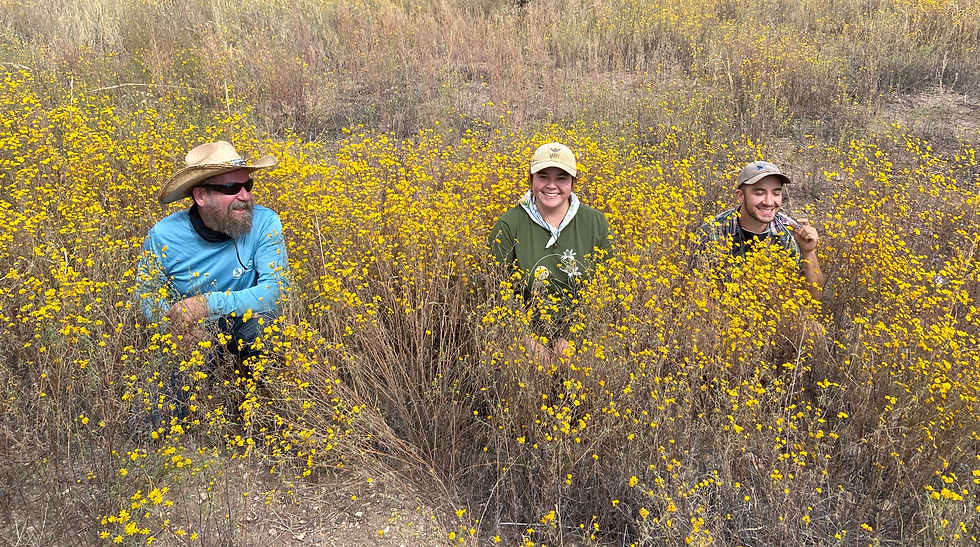
Three members of the Watershed Restoration Crew (Homo sapiens) stop to take a photo in a field of Showy goldeneye.


Comments